Barbless Hooks in Europe: What OEM Buyers Must Know
Barbless hooks are moving from niche to standard across European markets. Here is what to specify, what to check, and how to plan production.
European retailers are listing more barbless SKUs every season. Some angling waters already require them. Others are moving that way through catch-and-release rules and retailer policy. For an OEM buyer, the question is no longer whether to offer barbless, but which barbless variant to offer, and at what cost.
This guide covers the regulatory direction, the technical difference between barbless variants, what changes in manufacturing, and the spec questions to put on your RFQ.
The Regulatory Direction in Europe
The exact rules vary by country, by water, and by season. Some stillwaters and river stretches restrict barbed hooks entirely. Others permit barbless or micro-barbed only during catch-and-release conditions. The direction is consistent even where the details differ.
Retailers in major European markets are responding before the rules force them. Barbless options appear in entry-level sets, in match fishing ranges, and in catch-and-release product lines. Tournament circuits in several countries run barbless-friendly formats.
For OEM buyers, this means two planning tasks. First, confirm the rules for the target markets and waters. Second, decide how much of the range should be barbless-ready rather than a single compliant SKU. The second decision drives tooling, QC, and cost.
The retailer shelf is where the trend shows up first. Barbless sets appear in entry-level boxes, in match packs, and in catch-and-release lines from major brands. A buyer who waits for regulation will chase the market; a buyer who reads the shelf can lead it.
What "Barbless" Means in Practice
Three variants sit under the barbless label, and they are not interchangeable.
| Variant | Barb Removal | Production Impact | Holding Power | Best For |
|---|---|---|---|---|
| Debarbed | Ground or pressed flush after forming | Adds a deburring step; inspect every batch | Reduced | Retrofitting existing tooling |
| Molded barbless | No barb in the die, never formed | Dedicated dies; no extra deburring step | Lowest of the three | Volume production, consistent geometry |
| Micro-barb | Small retained barb, under local limits | Tighter tolerance on barb height | Closest to standard | Markets that allow micro-barb |
Debarbed hooks are the fastest way to offer a barbless line from existing tooling. Molded barbless hooks are the cleaner long-term solution when volume justifies dedicated dies. Micro-barb is the compromise that keeps holding power while staying inside many rules.
What Changes in Manufacturing
Debarbing adds a mechanical step. The barb is ground or pressed flush, then the hook moves through the same finishing line. The added step costs time, and it introduces a new QC point: leftover barb material on the point side.
Molded barbless removes the deburring step entirely. The die simply has no barb cavity. The cost shifts to tooling, which is why molded barbless suits volume SKUs with stable geometry.
Batch traceability becomes more important when a range mixes variants. A debarbed SKU and a molded barbless SKU from the same week can look identical on the shelf. Label each batch by variant and keep the QC records attached to the batch number, not the product family.
QC needs an explicit barb check either way. Measure barb height on a sample from every batch, and reject any unit that sits above the agreed limit. The measurement is simple, but it only exists if you specify it.
Coating and steel questions stay the same as standard hooks. Saltwater lines still need corrosion resistance, and the 500-hour salt spray test remains the reference point for coated ranges. See our saltwater performance guide for the coating picture.
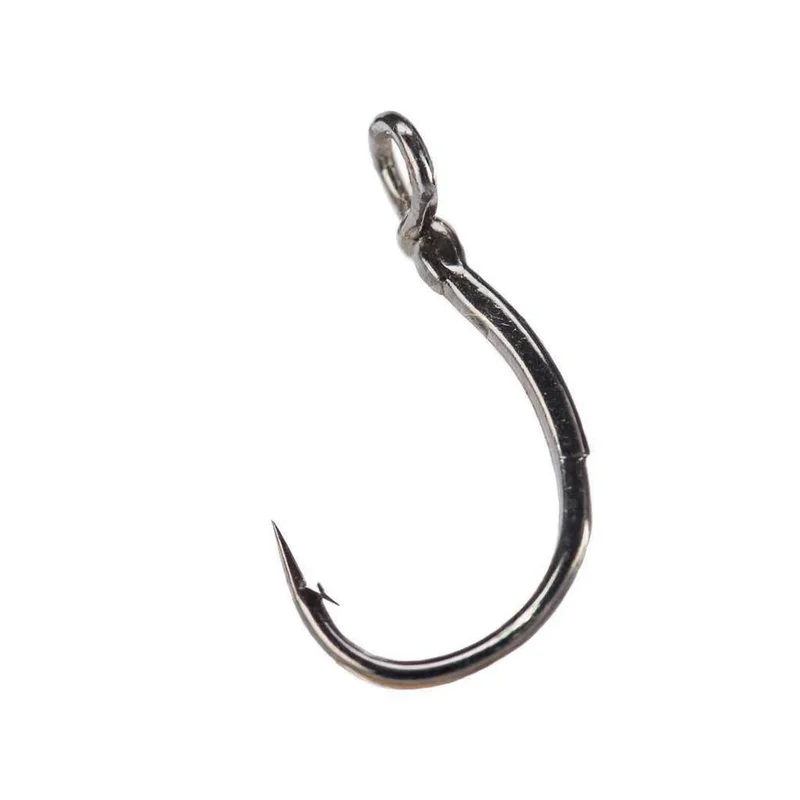
Point Geometry on Barbless Hooks
Removing the barb changes the penetration story. A barbed hook sets once the barb clears the skin and holds against pull. A barbless hook has no such anchor, so the point angle and the hookset become the whole game.
A clean, sharp point matters more on barbless hooks. If the deburring step rounds the point, the hook needs more force to penetrate and the fish has more time to throw it. Specify point angle and point finish in the same RFQ as the barb limit.
Gauge selection follows the same logic. A barbless hook in a heavier gauge needs a sharper point to compensate. Lighter gauges penetrate more easily but bend more easily in the fight. The balance is a spec decision, not an accident of tooling.
Spec Questions for Your RFQ
- Barb height limit: specify it in tenths of a millimetre and define the measuring method.
- Variant: debarbed, molded barbless, or micro-barb. Confirm which one matches the target market rules.
- Point geometry: barbless hooks still need a clean point angle. Do not let deburring round it off.
- Steel grade: match to the species and water type, using the same grade logic as standard hooks.
- Packaging and labeling: European retail lines often require multilingual labels and GS1 barcodes. Confirm before tooling the carton.
- MOQ and lead time: molded barbless tooling extends lead time; debarbed retrofits do not.
Which Markets Want Which
Freshwater match and coarse angling in the UK and western Europe lean toward barbless or micro-barbed across whole ranges. Scandinavian markets show a strong catch-and-release culture, especially in predator fishing. Southern European markets adopt barbless more selectively, often by water type.
Sea fishing moves more slowly. Saltwater hook sizes, heavier wire, and the practical need to hold bait mean barbless penetration is lower. Micro-barb is the more realistic entry point for sea ranges.
Plan by market cluster, not by a single rule. The range structure should mirror how the rules are actually applied, and your supplier should be able to produce all three variants from the same order flow.
Barbless is not a downgrade to plan around at the last minute. It is a spec decision with tooling, QC, and cost implications. Buyers who specify it early keep control of the range, the price, and the lead time.
Planning the Barbless Transition
The transition is easier to phase than to jump. Start with the SKUs that match the strictest rules in your target markets, then extend the barbless range as reorder data confirms demand.
Order samples of all three variants before committing tooling. Measure barb height, check point angle after deburring, and run a small wash of the range through your own quality gate. Sample approval is the contract, exactly as it is for any hook order.
Communicate the timeline to retail buyers early. European retailers set their ranges a season ahead, and a supplier who can confirm barbless capacity in the planning window earns the listing. A supplier who can only react to the order loses it.
For the base material question, the high carbon vs vanadium steel guide covers the grade decision. For catch-and-release positioning, the circle hook catch-and-release guide explains why hook design matters beyond the barb. The rust prevention guide covers the storage and finishing side of the same order.
Frequently Asked Questions
Do European regulations require barbless hooks?
The rules vary by country, water, and season. Some stillwaters and river stretches restrict barbed hooks, and retailers are adding barbless SKUs ahead of regulation. Confirm the rules for each target market rather than assume one standard.
What is the difference between debarbed and molded barbless hooks?
Debarbed hooks have the barb ground or pressed flush after forming, which adds a deburring step. Molded barbless hooks are formed without a barb in the die, which removes the extra step but requires dedicated tooling.
About the Author
FishingLineStrength supply team — 15+ years in fishing hook manufacturing.
Sources / Further Reading
- European Anglers Alliance (EAA) · angling advocacy and EU policy context
- UK Environment Agency angling rules · barbless and micro-barbed requirements by water
- IGFA · international catch-and-release standards and hook design guidance
- FishingLineStrength · 500+ hour salt spray testing lab data