Octopus Hook vs Circle Hook: When to Use Which
Octopus and circle hooks are the two most-requested round-bend patterns in saltwater and catfish programs, and they are also the two easiest to confuse. Both have short shanks and rounded bends, yet they hook fish in fundamentally different ways. For buyers building an OEM line, that difference decides which patterns you stock.
Brands adding their first round-bend pattern typically ask the same question. Octopus and circle hooks are not substitutes; they are two hooking systems for two fishing styles, and successful product lines carry both. This guide covers the geometry, the fishing scenarios, the target species, and the OEM specification choices.
Quick Answer
Octopus hooks are strike-set hooks for live bait and soft-mouthed fish. Circle hooks are tension-set hooks for dead bait, still fishing, and catch-and-release. If the angler is holding the rod and setting on a live bait, choose octopus. If the bait sits still and the rod does the work, choose circle. The rest of this article explains why, and how to spec both for your market.
Geometry: What Actually Differs
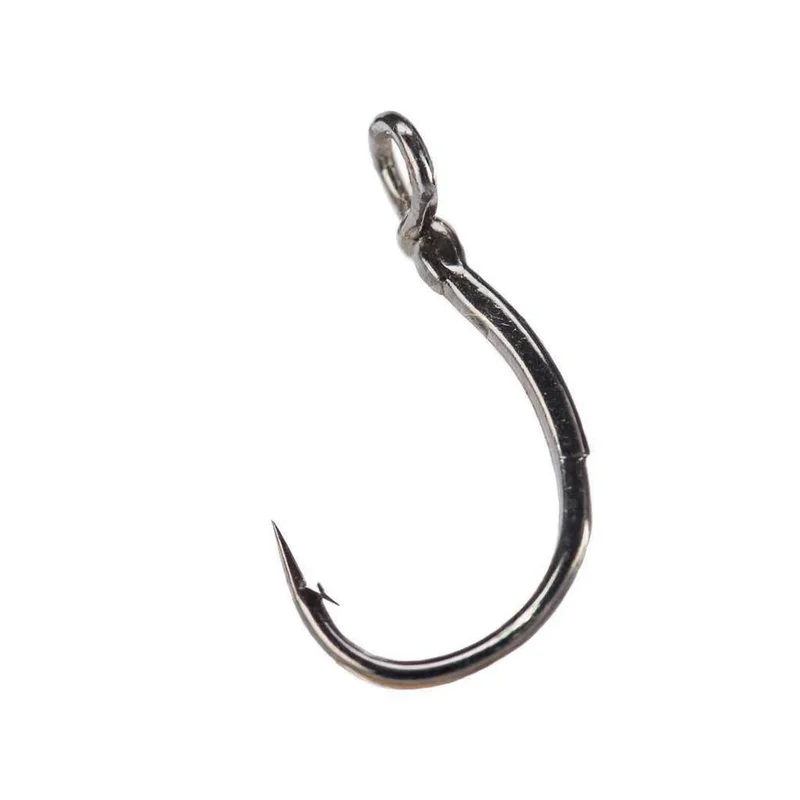
The visible difference is the point. On a circle hook the point turns inward toward the shank, a few degrees past vertical, forming an almost closed hooking edge, so the hooking edge forms an almost closed ring. On an octopus hook the point runs roughly parallel to the shank, closer to a J-hook. That single difference changes everything downstream: penetration timing, hooking location, and the hookset skill required from the angler.
The eye is the second difference. Octopus hooks usually carry a turned-down or turned-up eye, which helps a live bait ride naturally. Circle hooks use a straight ringed eye inline with the shank, so the hook tracks straight as tension builds. The shank differs too: the octopus has a short, direct shank for quick penetration, while the circle hook's longer, rounder sweep gives it room to rotate into the jaw corner.
Hooking Mechanics: Live Bait vs Dead Bait
With a live bait, an octopus hook is rigged through the nose or back of the baitfish with the point exposed. The angler sets on the first pull, and the parallel point drives straight into the jaw. This is why octopus hooks dominate live-bait fishing for everything from trout on minnows to redfish on live shrimp. The hook must match a small, active bait and penetrate immediately, with no waiting.
A circle hook is not meant to be struck. When a fish takes a dead bait or cut bait and swims away, line tension pulls the hook across the mouth until the inward point catches the corner of the jaw and rotates in. That is why circle hooks are standard for still fishing, drift fishing, and slow trolling, where rods sit in holders and the fish hooks itself. The trade-off is that a circle hook needs that rotational pull to work. On a finicky live bait that is picked up and dropped, or on a very small soft bait, an octopus pattern will hook more fish.
The corollary is hooking location. A circle hook almost always ends up in the jaw corner, which is why non-offset circle hooks are recommended for catch-and-release fisheries. An octopus hook can be swallowed when fished on dead bait with a delayed hookset. We cover the mechanics in depth in our guide to circle hooks in catch-and-release fisheries.
Target Species: Who Prefers What
Catfish. This is the classic split. Channel catfish on cut bait or prepared bait are almost always fished with circle hooks, because the self-setting corner-of-mouth hookset suits still fishing and reduces gut-hooked fish. Blue catfish on live bait, especially live shad or bluegill, are more commonly fished with octopus hooks, because the angler is setting on an aggressive take and wants immediate penetration.
Trout. Small octopus hooks in sizes #6 to #2 dominate live-bait drift fishing, where the hook must ride a small minnow or worm without deadening the action. Circle hooks appear in trout programs mainly where catch-and-release rules apply or where the fishery targets larger fish on bait.
Saltwater. Snapper and grouper fisheries in several regions now require circle hooks, and non-offset circles are mandatory for billfish tournaments and shark fishing in US federal waters. Redfish and speckled trout take both: octopus for live shrimp, circles for cut bait on the bottom. Tuna on live bait is largely a circle-hook fishery. A full comparison of round-bend patterns is in our round bend vs O'Shaughnessy vs treble guide.
Hook Size Comparison
Octopus and circle hooks of the same numeric size are not interchangeable. Because the circle hook's point turns inward, the effective bite width is smaller, so for the same bait and species most anglers step up one to two sizes when switching from octopus to circle. As a rule of thumb, a 3/0 octopus roughly corresponds to a 4/0 or 5/0 circle for the same bait.
For OEM buyers the consequence is practical: both patterns must be specified separately, with their own size ranges, wire gauges, and bend proportions, even when they share a coating. Size numbering systems, tolerances, and how to state dimensions on a spec sheet are covered in our hook sizing guide for OEM buyers.
OEM Angle: Steel, Coating, and Point
Both patterns are produced in the same wire families in our factory: high-carbon steel for freshwater and inshore programs, 304 or 316 stainless for saltwater lines. The practical difference is load path. A circle hook is pulled against the jaw corner under rod pressure, so heavier gauge matters more; an octopus hook is driven in by the angler's hookset, so point sharpness and wire consistency matter more. Material selection is covered in 304 vs 316 stainless steel.
Coating choice follows the program, not the pattern. Black nickel is the default for both in freshwater and inshore, gold for presentation-focused lines, and HI-TECH black for long-exposure saltwater. In saltwater and catfish programs where hooks stay baited for hours, coating thickness matters more than pattern choice. The trade-offs between the two most common finishes are detailed in our black nickel vs 24k gold coating comparison.
Point finish is where the two patterns diverge most at production level. A circle hook's inward point must be ground to a sharp, consistent needle point, because penetration happens without an aggressive hookset. An octopus hook's parallel point needs the same sharpness but tolerates a wider range of point geometries. The full comparison of cutting point, flat point, and SR point applies to both.
For procurement, both patterns can be mixed in a single production run with shared coatings and packaging, which keeps MOQs manageable for brands that want to carry both. Lead times, minimum order quantities, and how to structure a mixed-pattern order are covered in our OEM hook orders, MOQ, and lead times guide.
Decision Table: Which Hook for Which Scenario
| Scenario | Octopus Hook | Circle Hook |
|---|---|---|
| Live bait, active hookset | Recommended | Optional (larger baits) |
| Dead bait, cut bait, still fishing | Works | Recommended |
| Drift or slow troll, rods in holders | Not ideal | Recommended |
| Catch-and-release or regulated fisheries | Caution (deep hooking risk) | Recommended |
| Soft-mouthed species (trout, flounder) | Recommended | Works with larger sizes |
| Hard-mouthed, aggressive species (catfish, snapper) | Works | Recommended |
Two patterns, two jobs. A brand that stocks only one is leaving hookups on the table in the other. Most successful programs carry octopus for live-bait customers and circle for still-fishing and conservation customers, sharing coatings and packaging across both.
FAQ
Which hook is better for live bait fishing, octopus or circle?
Octopus hooks are generally better for live bait. Their point runs parallel to the shank, so the hook penetrates immediately on the first pull. Circle hooks work with larger live baits, but they need steady line tension to rotate into the jaw corner.
Do circle hooks set themselves?
Yes, when fished correctly. The angler applies steady pressure, and the hook slides through the mouth until line tension pulls it into the jaw corner, where the inward point rotates in and sets.
What size circle hook equals an octopus hook?
The circle hook's inward point gives it a smaller effective bite width than an octopus of the same number. As a starting point, step up one to two sizes, for example from a 3/0 octopus to a 4/0 or 5/0 circle.
Can you use a circle hook for trout?
Yes, where catch-and-release is practiced. For live-bait drift fishing with small minnows or worms, small octopus hooks in sizes #6 to #2 are the more common choice.
Planning an octopus, circle, or mixed round-bend line for your brand? Contact our supply team for samples, size range options, coating specifications, and OEM pricing on both patterns.
About the Author
FishingLineStrength supply team — 15+ years in fishing hook manufacturing.
Sources / Further Reading
- •NOAA Fisheries. Catch and Release Fishing Best Practices. Recommendations on circle hooks and survival rates.
- •FishingLineStrength. Circle Hooks in Catch-and-Release: Why Design Matters. Deep-hooking reduction data and the 9999, 9998, and Killer model specifications.
- •FishingLineStrength. Hook Sizing Guide for OEM Buyers. Size numbering conventions and dimensional specification for octopus and circle patterns.