Fishing Bedchairs for Side Sleepers: A B2B Buyer's Guide
Table of Contents
I spent 15 years on factory floors before I ever slept on a carp bedchair. The first time I did, I woke up with a dead arm and a stiff hip. I'm a side sleeper. The bedchair was flat, firm, and designed for someone who sleeps on their back like a plank.
The next morning, standing in the QC bay looking at our standard bedchair frame, I thought: half the anglers I know sleep on their side, and nobody is building for them.
That observation turned into one of our best-selling SKUs. Here is what I learned about the side-sleeper bedchair market, and what distributors should look for when sourcing.
Why Side Sleepers Are an Underserved Market
Walk through any trade show and count the bedchairs marketed for side sleepers. You will find maybe two among fifty models. Yet informal surveys on carp fishing forums consistently show 40-50% of anglers identify as side sleepers.
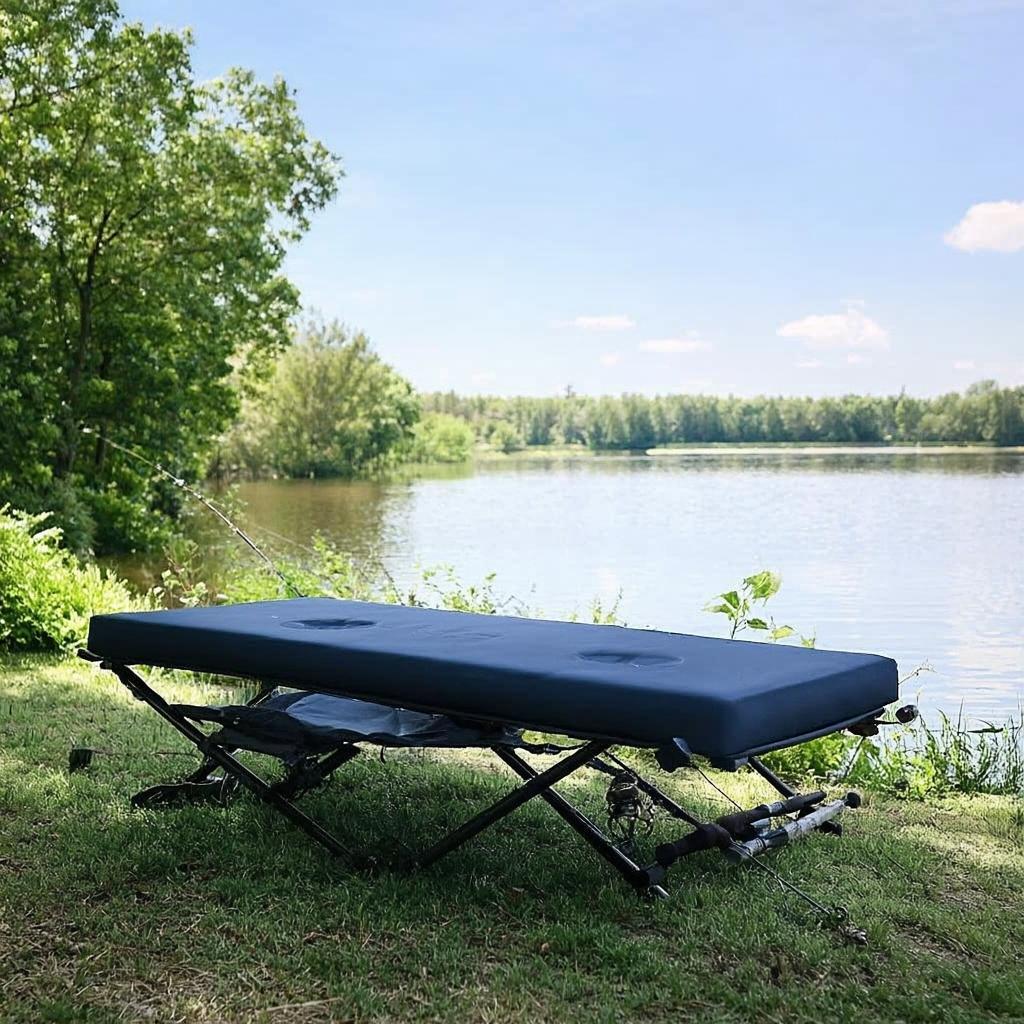
The standard bedchair design assumes the user sleeps flat on their back. The mattress is 5-7cm thick with uniform density foam. The width is 65-75cm. This works for back sleepers. For side sleepers, it creates three problems:
Hip pressure. When you sleep on your side, your hip becomes a single pressure point against a flat mattress. After 4-6 hours, the compression cuts circulation to the leg. Anglers wake up with dead-leg numbness — not what you want at 3 AM when your buzzer goes off.
Shoulder collapse. A side sleeper's shoulder needs 3-5cm of sink into the mattress. On a standard 5cm foam pad, the shoulder hits the frame bar underneath. The solution is either thicker foam (8-10cm) or a zoned mattress with softer shoulder panels.
Width restriction. A side sleeper with knees bent takes up more lateral space than a back sleeper. Standard 70cm width feels cramped. 80-85cm is the minimum for comfort, and 90cm is ideal.
These are not minor complaints. They are design flaws that a supplier can fix, and a retailer can sell against.
What Specs Actually Matter for Side-Sleeper Bedchairs
When evaluating a bedchair for side-sleeper suitability, three specs separate the real product from the marketing claim:
### Mattress Thickness and Zoning
The minimum functional thickness for a side sleeper is 8cm. Below that, the hip bottoms out against the frame. The best designs use dual-zone foam: 10cm in the shoulder/hip zone tapering to 6cm in the leg zone. This adds weight but solves the pressure point problem without making the whole mattress feel like a sponge.
Look for suppliers who can specify foam density separately from thickness. 28-32kg/m³ high-resilience foam in the pressure zones with 22-25kg/m³ in non-contact areas is the sweet spot. Anything under 20kg/m³ everywhere is budget foam that will flatten in one season.
### Frame Width
80cm minimum, 85cm comfortable, 90cm generous. The difference between 75cm and 85cm sounds small on paper. On a lakeside at 2 AM, it is the difference between sleeping and not sleeping.
Wider frames add weight and cost. The aluminum extrusion is longer, the fabric is wider, the packed size is larger. This is why most manufacturers default to 70-75cm. It is cheaper and easier. A supplier who offers 85cm+ as a standard option, not a custom order, understands the market.
### Elevated Head Section
Side sleepers benefit from a head section that can incline 15-25 degrees. This aligns the spine and reduces shoulder compression. Most standard bedchairs have a flat or minimally-adjustable headrest. A multi-position ratchet mechanism with 4-6 lock points is a strong selling feature.
For B2B buyers, check that the mechanism is metal, not plastic. Plastic ratchets fail. I have seen entire container loads returned because the adjustment mechanism snapped in cold weather. Metal ratchets cost $2-3 more per unit and eliminate the failure mode entirely.

How to Position This Product for Retail Customers
The side-sleeper bedchair is not a high-volume item. It is a margin product for retailers who want to differentiate.
Price point: Retail $180-280. This sits between the budget flat-bed ($80-120) and the premium sleep system ($350-500). It is an upgrade sale for anglers who already own a basic bedchair and are tired of waking up sore.
Margin structure: Factory cost on a well-built 85cm zoned-foam bedchair runs $55-75 FOB. At wholesale $95-120, the retailer has room to sell at $200-250 with 45-50% margin. Compare that to standard bedchairs where retail competition pushes margins to 25-30%.
Marketing angle: Do not sell the specs. Sell the morning. "Wake up ready to fish, not needing a chiropractor." Side sleepers know they have a problem. Show them the solution exists and they will upgrade.
One UK retailer we supply added a side-sleeper bedchair to their range last year. It is now 18% of their bedchair revenue on 12% of unit volume. Higher margin, lower volume, same shelf space.
What to Ask Your Supplier
Before placing an order, ask these four questions:
"What is the foam density in the shoulder zone?" If they cannot answer in kg/m³, they are buying generic foam and slapping a label on it. Walk away.
"Is the adjustment mechanism metal or plastic?" Metal only. No exceptions for price.
"Can you provide a sample with 85cm width before bulk order?" A supplier who refuses to send one sample is not confident in their product. Legitimate factories will send samples at cost.
"What is the packed size with the wider frame?" An 85cm bedchair in a carry bag should pack to roughly 85x30x25cm. If it is significantly larger, the frame design is inefficient and transport costs will eat your margin.
The Bottom Line
The side-sleeper bedchair is not for every angler. But for the 40-50% who sleep on their side, it solves a real problem that standard bedchairs ignore. For distributors and retailers, it is a differentiated SKU with better margins than the commodity bedchair segment.
The factory capability exists. The foam technology exists. The market demand exists. What is missing is suppliers and retailers willing to spec the product correctly instead of just slapping a wider mattress on a standard frame. Do the spec work. Your customers will notice.
*Heinz Industrial supplies OEM bedchairs and sleeping systems to distributors across Europe and North America. All frames use 6061 aluminum extrusion with metal ratchet mechanisms. Foam specs are specified to kg/m³, not just thickness. Contact us with your requirements.*
Sourcing OEM Carp Cradles?
We have been cutting, stitching, and testing carp care products on the factory floor for over 15 years. If you need a spec review of your current cradle PO, material samples, or a full OEM carp care procurement programme, get in touch.
Contact Us About OEM Cradle Sourcing